
Introduction
No engineering calculation is ever perfectly complete.
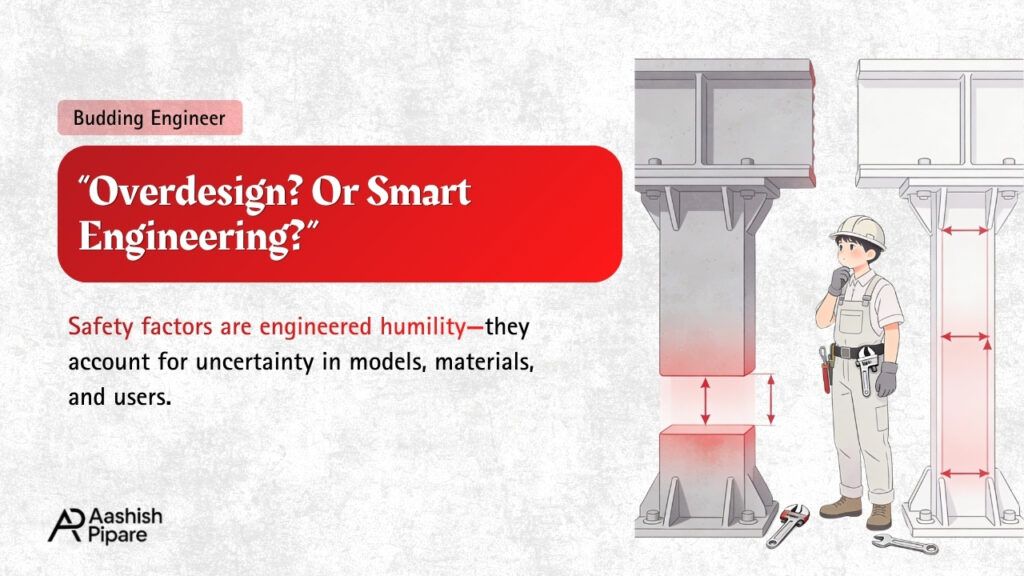
A safety factor exists to protect systems from the gaps between what we know—and what reality will reveal.
Safety Factor as Acknowledgment of Uncertainty
For a budding engineer, a safety factor may initially seem like a simple multiplier added to a design. But in reality, it represents something deeper.
It is an admission that:
- calculations are based on simplified models
- materials do not behave identically every time
- real-world conditions are never perfectly predictable
Even the most careful design cannot capture every variable. The safety factor exists because engineering is not performed in a perfect world.
It is not a sign of weakness—it is a sign of awareness.
Why Perfect Design Is Not Enough
In theory, a system designed exactly to its expected load should work. But in practice, systems experience variations:
- loads may exceed expectations
- materials may have hidden defects
- environmental conditions may change
- usage may differ from intended design
A design without a safety factor operates too close to its limits. Any deviation—even a small one—can lead to failure.
For a budding engineer, the lesson is clear:
designing for “just enough” is often not enough.
The Role of Human Behavior
One of the most unpredictable elements in engineering is the human factor.
Users do not always behave as expected:
- systems may be overloaded
- equipment may be misused
- maintenance may be delayed
A safety factor accounts not only for physical uncertainties, but also for unpredictable human interaction.
It protects the system from scenarios that were not explicitly planned but are likely to occur.
Balancing Safety and Efficiency
While safety factors are essential, they cannot be applied blindly.
A very high safety factor:
- increases cost
- adds weight or complexity
- reduces efficiency
A very low safety factor:
- increases risk
- reduces reliability
Engineering judgment lies in choosing a safety factor that balances:
- risk
- cost
- performance
- consequences of failure
For a budding engineer, this is where thinking evolves—from calculation to decision-making.
Safety Factor as a Design Philosophy
A safety factor is not just a number—it reflects how you think about uncertainty.
It forces you to ask:
- What have I not considered?
- How wrong could my assumptions be?
- What happens if conditions change?
In this way, the safety factor becomes a structured way of thinking about the unknown.
It is not only about protecting the system—it is about respecting the limits of your own understanding.
When Safety Factors Are Ignored
Ignoring or minimizing safety factors can lead to designs that appear efficient but are fragile.
Such systems may:
- perform well initially
- fail unexpectedly under stress
- have little tolerance for variation
These failures are often not due to poor calculation, but due to overconfidence.
For a budding engineer, one of the most important lessons is this:
confidence must always be balanced with caution.
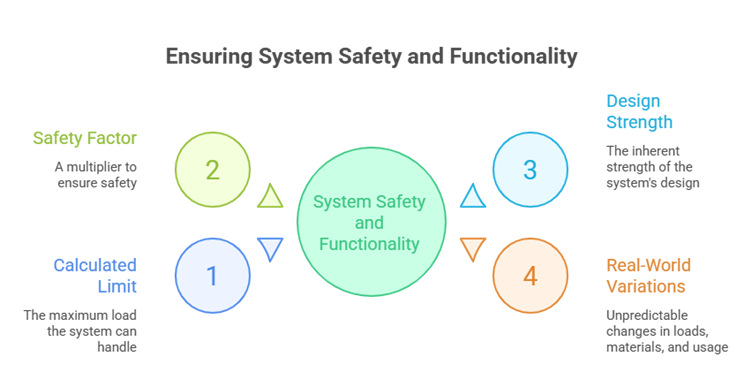
Visual Representation
Practical Table
| Factor / Question | Why It Matters | Example |
| What uncertainties exist? | Identifies where safety margins are needed | Unknown environmental loads |
| How reliable are materials? | Materials vary in strength and behavior | Variations in steel quality |
| What is the consequence of failure? | Determines required level of safety | Higher safety in bridges than in temporary structures |
| How might users behave? | Accounts for misuse or unexpected usage | Overloading of equipment |
| What is the acceptable risk? | Balances safety with cost and efficiency | Choosing factor based on industry standards |
Key Takeaways
- A safety factor accounts for uncertainty in real-world systems
- It protects against variations in loads, materials, and usage
- Perfect calculations do not guarantee safe performance
- Human behavior is a major source of unpredictability
- Safety factors must balance risk and efficiency
- It represents humility and awareness in engineering design
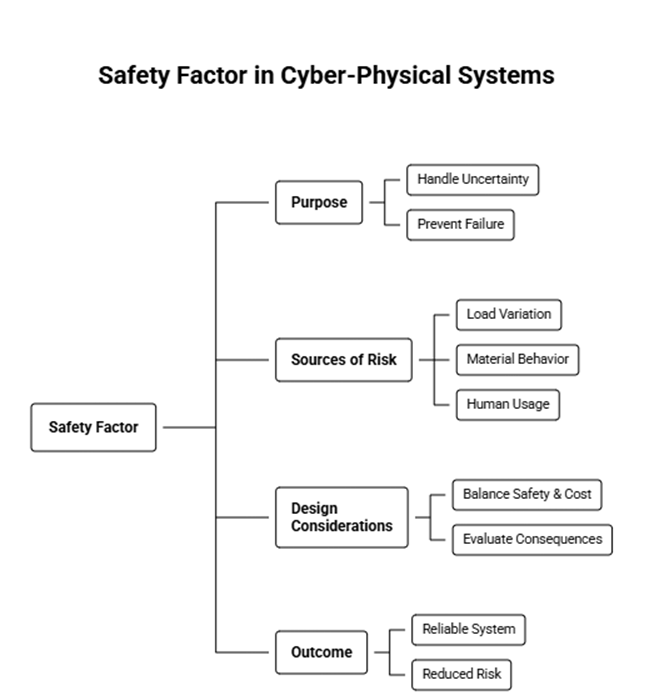
Mind Map
Conclusion
A safety factor is more than a design parameter—it is a reflection of engineering mindset.
It acknowledges that no model is perfect, no material is identical, and no system operates exactly as planned. It introduces a margin not just for error, but for reality itself.
For a budding engineer, the deeper lesson is not about adding a number—it is about thinking with humility.
Because strong systems are not built on certainty alone—
they are built on the understanding that uncertainty will always exist.